From Agriculture to Surveying: Drones Shine Across Multiple Sectors
In recent years, drone technology has expanded its applications from agriculture and surveying to transportation, rescue operations, and beyond, rapidly transforming work methods across various fields. Recently, in Shawan Town, Jingning She Autonomous County, Lishui, Zhejiang Province, a kind-hearted villager successfully rescued a fisherman trapped in the middle of a river using an agricultural drone.
After the emergency occurred, rescuers rushed to the scene, but due to the rapid current, rubber boats could not be used, and they had to borrow bamboo rafts from nearby villagers. The drone can carry a lifting weight of up to 150 kilograms, which usually exceeds an adult’s body weight. Villager Chen Wangdi holds a drone operation qualification certificate and has rich experience in using drones for agricultural production and heavy object transportation in mountainous areas.
As the situation was urgent and the river water continued to rise, Chen carefully maneuvered the drone to hover above the trapped man and lowered a safety rope. After the man secured the rope around his waist, the drone slowly lifted him from the middle of the river to a safe area.
Fire and rescue officials emphasized that this drone-assisted human rescue was conducted under critical circumstances with traditional rescue forces on standby. Using agricultural plant protection drones to carry or lift people is strictly prohibited in daily situations.
According to fire departments, drones are widely used in emergency rescue scenarios such as fire fighting, earthquake relief, water rescue, and mountain search and rescue. Equipped with high-definition cameras and thermal imagers, drones can quickly locate targets and assess the surrounding environment, providing a basis for formulating rescue plans. Additionally, drones can establish temporary communication networks on-site to ensure smooth information flow between the command center and rescuers, while helping to avoid potential risks during rescue operations.
Real-Time Monitoring for Forest Patrols and Early Warning
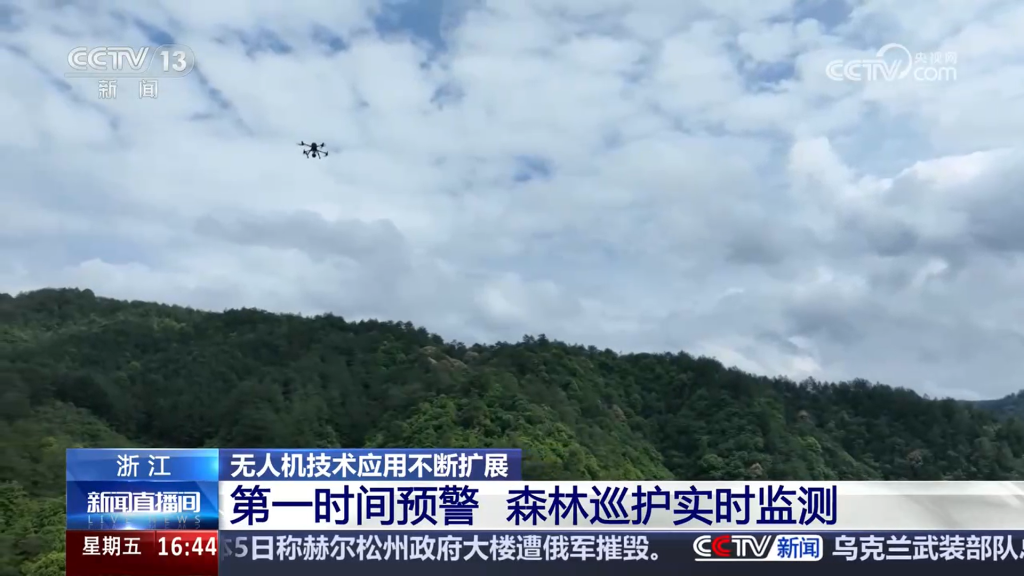
Drones also play a crucial role in improving fire prevention inspection and rescue efficiency. Recently, in Qianjiangyuan-Baishanzu National Park (Candidate Area), a drone detected suspected smoke in farmland on the park’s periphery, and the system issued an immediate early warning.
In the Qianjiangyuan Park of Qianjiangyuan-Baishanzu National Park (Candidate Area), when the drone spotted the suspected smoke, the system instantly sent early warning text messages to administrators and rangers at all levels. Within 15 minutes, the outdoor fire was extinguished. It is reported that the park is equipped with multiple drone patrol devices, gradually establishing a 24/7 three-dimensional collaborative management “smart brain.”
To date, the park has handled over 300 incidents such as suspected smoke and water pollution through drone inspections. It can basically complete patrols of 16 square kilometers of mountain forests in 30 minutes and full coverage of inspections within 7 days, increasing the overall patrol efficiency by more than 15 times compared with traditional models.
In the Baishanzu Park of the same national park (Candidate Area), a forest fire-fighting drill was underway. The drones used here can not only perform automatic patrols but also deliver rescue supplies, with a maximum load capacity of 110 kilograms. Tasks such as transporting water bags to mountainous areas and conducting fire-extinguishing operations above designated fire points can all be accomplished by these load-carrying drones.
Cargo-Carrying Drones: Time-Saving and Labor-Saving Aerial Transport
In agricultural production, drones are becoming increasingly widespread. Applications such as drone crop protection and transportation have improved production and management efficiency.
Early in the morning, potato harvesting began in Yangtangbei Village, Langya Town, Wucheng District, Jinhua, Zhejiang Province. After digging, sorting, and bagging, agricultural cargo-carrying drones took over the transportation link.
Two large bags of potatoes, weighing approximately 100 kilograms, were lifted by a drone from the field to a transport vehicle parked by the road in one trip. The efficiency is 5 to 7 times higher than manual handling. Meanwhile, drone transportation reduces collisions during transit, ensuring the quality and appearance of the potatoes.
Plant Protection Drones: Efficient and Precise “Aerial Application” Operations
In addition to transportation, drones excel in agricultural “aerial application” operations. Currently, it is a critical period for early rice tillering and jointing. In Youbu Town, Lanxi, Zhejiang Province, drones loaded with fertilizers are conducting “aerial application” in the fields. Flying at a steady speed over the rice paddies, the drones spray a mixture evenly from nozzles under the fuselage, saving time and reducing labor costs with high efficiency and precision.
Currently, agricultural drones have become one of the core tools of smart agriculture, playing roles in plant protection spraying, sowing and fertilization, and farmland surveying. In the future, the unmanned farm model integrating “drones + Internet of Things + robots” will accelerate its popularization.
Drones + Robots: High-Efficiency High-Rise Cleaning
Drone technology is being applied in more and more scenarios, including urban management. In Nanjing, Jiangsu Province, drones not only act as “spider men” to clean the glass curtain walls of high-rise buildings but also can quickly and accurately locate “pollution sources.”
Recently, Nanjing’s urban management department attempted for the first time to use a “drone and robot” combination to clean building facades. A drone equipped with cleaning equipment, controlled by an operator, steadily flew to the top of the building. The drone was responsible for accurately spraying cleaning fluid with high-pressure water to rinse the facade, while the cleaning robot first sprayed steam to melt surface stains and then used robotic arms to scrape off dirt from the glass curtain walls. The entire process is efficient and smooth, solving the safety risks of “spider men” working at heights, especially in complex environments, and significantly shortening the working time. In the past, cleaning a 30-story building required 12 workers to work in shifts for 3 days; now, the drone-robot team can complete it in half a day.
“Drone + AI Recognition”: “Hourly-Level” Dynamic Monitoring
In urban ecological environment management, drones also perform brilliantly. High temperatures in summer tend to exacerbate ozone pollution, increase the risk of water eutrophication, and cause the spread of odors from solid waste. Manual inspections cover a wide area and are difficult to achieve full coverage. Pukou District, Nanjing, has innovatively built the city’s first “low-altitude intelligent supervision platform for ecological environment.” Through a technology cluster of “drones + AI recognition,” it has upgraded traditional manual inspections from “daily frequency” to “hourly-level” dynamic monitoring.
Drones can conduct daily inspections of grid areas along preset routes and transmit data back to the rear in real time. Through the intelligent decision-making center, they provide intelligent early warnings for 11 types of pollution factors including PM2.5. Once abnormal values are detected, an early warning mechanism is triggered, and law enforcement personnel receive relevant prompts.