
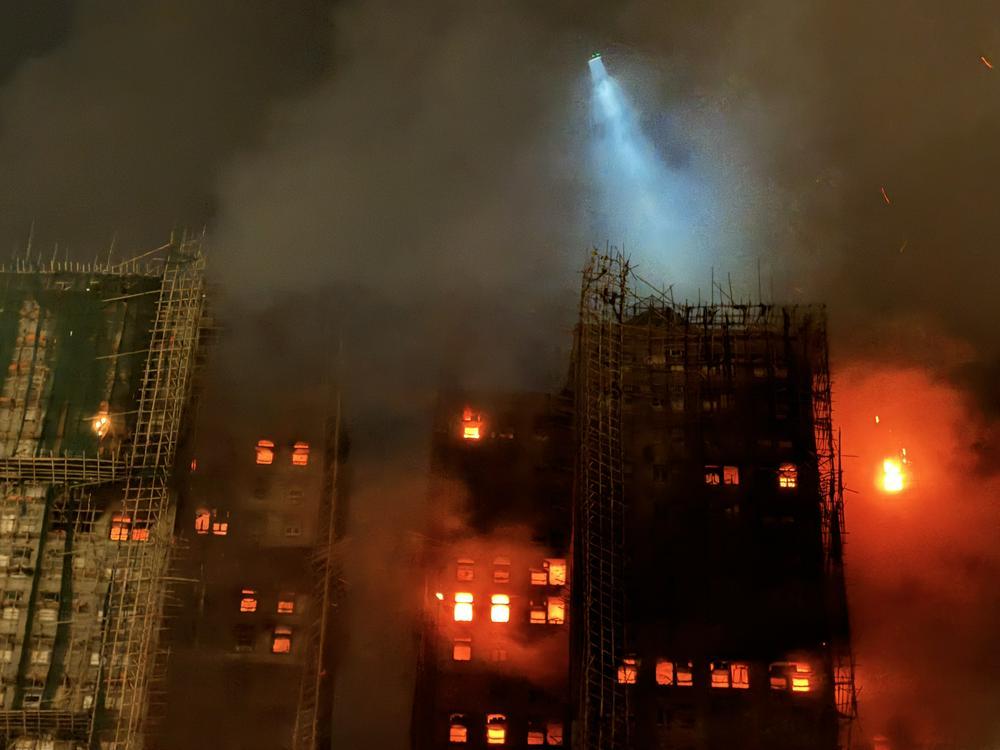
At 1:00 a.m. today, reporters from Cailian Press observed multiple drones hovering above the fire scene of the Tai Po fire accident in Hong Kong. A police officer at the scene confirmed to the reporter that the drones deployed by the Fire Services Department and the Police Force are mainly used for fire scene reconnaissance and auxiliary lighting.
When facing fires at heights of hundreds of meters with complex facade structures, traditional ground-based equipment faces significant limitations in reach. This should have been the optimal scenario for high-rise fire-fighting drones to play a “special forces” role. However, the actual combat results of the Tai Po fire show that current drone technology still lacks practical intervention capabilities.
Reporters consulted multiple industry insiders and learned that the application of drone firefighting, especially in high-rise buildings, still faces numerous technical and regulatory challenges. There is still a long way to go before large-scale practical application and standardized promotion.
Firefighting Drones: Low Sales and Small Business Share
Reporters called several listed companies that have publicly stated they have firefighting drone businesses and learned that the contribution of firefighting drone operations to their overall performance remains minimal.
A staff member from the Securities Department of Hailunzhe (300201.SZ) confirmed to Cailian Press that the company’s first-generation high-altitude drone fire-fighting vehicle has been launched on the market, but “only three units have been sold” so far. The company’s second-generation product has just been released, and currently, this business accounts for a “very small” proportion of the company’s overall revenue structure, with the main business remaining specialized vehicles.
A staff member from the Securities Department of Chen’an Technology (300902.SZ) expressed a similar view. The staff member said that its wholly-owned subsidiary Keda Li’an has a firefighting drone business targeting building facades, but currently, the “proportion is not significant.”
According to the introduction, the company’s business model mainly involves purchasing drone platforms from manufacturers such as DJI and equipping them with self-developed fire detection models and fire-fighting equipment. Customers are mainly concentrated in professional fire-fighting agencies and some enterprise parks, with very little demand from individual users. Regarding the relevant stock price fluctuations today, the staff member admitted: “I think many people may have paid attention because of the (Hong Kong fire) news.”
A person from the Securities Department of Qingniao Fire Protection (002960.SZ) told Cailian Press that the company’s pulse water cannons can be mounted on firefighting drones. However, the company’s firefighting drone business has not yet formed stable revenue. “It’s just a direction; we are currently conducting research and development.”
A person from the Securities Department of Guo’anda (300902.SZ) stated that the company has entered the firefighting drone field through its holding subsidiary Keweitai, but the main products are still under research and development, and have little impact on the listed company’s revenue.
Current Technical Paths Have Limitations; System Construction Remains to Be Improved
At the practical application level, multiple interviewees pointed out the physical limitations of current technical paths.
It is understood that currently, the mainstream fire extinguishing methods include “water-based fire extinguishing” and fire-extinguishing bombs.
Sun Liye, Vice President of United Aircraft Group, told reporters that in urban scenarios, due to more abundant fire-fighting resources, “water-based fire extinguishing” is more effective; while in outdoor locations such as forests, fire-extinguishing bombs are more commonly used.
Projecting fire-extinguishing bombs is the path chosen by more small and medium-sized firefighting drones. A sales manager from Qingjiang Intelligence, an industrial drone company, told Cailian Press that the DJI firefighting drones the company acts as an agent for extinguish fires by projecting fire-extinguishing bombs, with a product price of approximately 300,000 to 400,000 yuan per unit.
However, Sun Liye told reporters that such small drones can carry a limited number of fire-extinguishing bombs and fire-extinguishing capacity, which is a drop in the bucket when facing large-scale fires.
On the other hand, for most current drone products, “water-based fire extinguishing” still faces significant bottlenecks.
The aforementioned sales manager from Qingjiang Intelligence told reporters that in the face of large-scale high-rise fires, the practical effect of most existing drones is limited. “The water volume of the drone’s nozzles is too small to have a significant effect on large fires.”
A person from the Securities Department of Qingniao Fire Protection detailed the current technical contradictions of “water-based fire extinguishing” to reporters. The person pointed out that firefighting drones have significant limitations in building fire extinguishing. If it is a small drone, it cannot overcome the reaction force generated by high-pressure water flow; if a large drone is used to carry a water pipe into the air, the weight of the water pipe itself and the air currents will restrict its flight height and stability.
The person also clearly stated that due to the above limitations, firefighting drones are not currently the main research and development direction of Qingniao Fire Protection, and the company is currently focusing more on ground fire-fighting equipment such as quadruped robots (machine dogs).
Luo Jun, Chairman of the Future Low-Altitude Economy Innovation Center in Chengdu Tianfu New Area, analyzed the difficulties of high-rise fire extinguishing from the perspective of environmental interference in an interview with Cailian Press.
Luo Jun pointed out that when a high-rise building fire occurs, the scene is often accompanied by complex turbulent flows and strong wind fields, which put forward extremely high requirements for the wind resistance level and flight stability of drones. If the drone’s power is insufficient, it is difficult to maintain a stable attitude for precise operations under the interference of strong winds and thermal currents.
“To solve the problems of water volume and power, we must rely on large-scale drone swarms for coordinated operations in the future,” Luo Jun believes. Single-drone operations cannot cope with large-scale fires; it is necessary to organize 10 or even 20 drones to form a formation to implement “saturation” bombing or spraying.
It is worth mentioning that relevant technologies are already breaking through and developing. Sun Liye told Cailian Press that United Aircraft’s TD550 firefighting unmanned helicopter is currently at the forefront of the industry. Compared with battery-powered drones, United Aircraft’s firefighting unmanned helicopter has a larger load capacity, longer range, and better wind resistance, which enables it to relatively well achieve “carrying water upstairs.” Currently, fire departments in Anhui and Sichuan have adopted the company’s firefighting drones.
However, the price of such drones is correspondingly higher. Sun Liye revealed to Cailian Press that unlike small firefighting drones priced at hundreds of thousands of yuan, the price of the company’s TD550 firefighting unmanned helicopter is several million yuan.
In Luo Jun’s view, realizing “drone firefighting” is not only a hardware technology issue but also a system construction issue. Currently, the industry lacks relevant airspace management rules and coordinated command systems.
“Firefighting drones are still in their infancy, and there is still a long way to go before large-scale practical application and standardized promotion. In the future, the industry needs to pay attention to a series of issues such as professional training in firefighting drone operation technology, standard systems for coordinated command of drone swarms, technical standards for high-power firefighting drones, and how fire-fighting foam or fire-extinguishing bombs can coordinate with drones.”
Sun Liye also stated that he calls on the industry to pay attention to the potential positive impact of drones on fire fighting in the future: “Firefighting drones are a brand-new field, and the industry needs innovation and attempts.”